
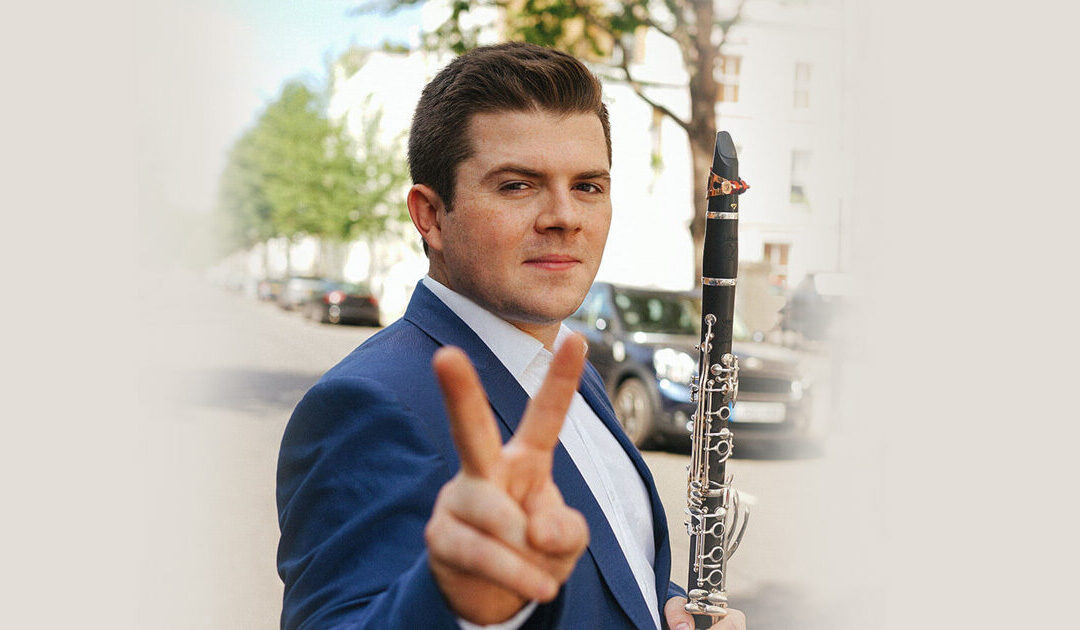
In a recent interview with Music & Artists, British-born Julian Bliss described his earliest days as a music student and professional clarinetist as “unconventional,” beginning with how he took up the clarinet at the age of four (which is earlier than usual due to the instrument’s physical and technical demands) and made his first television appearance as a clarinetist at the age of five.
But that was just for starters. By the age of eight, Bliss had enrolled in England’s prestigious Purcell School for Young Musicians, and by the age of 10 he’d moved to the United States to study at Indiana University. By the age of 12, he’d earned his postgraduate artist’s diploma and won the 2001 Concerto Soloists Young Artists Competition, which was held in Philadelphia. Bliss then moved back to England, but he traveled to Germany to study with Sabine Meyer, whom he called, in that same Music & Artists interview, “the greatest clarinet soloist.”
Building on those recent US successes, Bliss—the day before his 13th birthday, in 2002—made another pivotal move: He performed at the Prom at the Palace, which was held in Buckingham Palace Garden as part of Queen Elizabeth II’s Golden Jubilee. Four years later, Bliss performed for the queen again, when, as part of the BBC Proms, he appeared with the BBC Symphony Orchestra at the Royal Albert Hall for the queen’s 80th birthday celebration.
In the decades since those early-aughts achievements, Bliss has appeared with leading orchestras and at leading festivals around the world, and he’s become an in-demand educator through his master classes, coaching sessions for chamber ensembles, and more. In 2010, inspired by his love of jazz and for “King of Swing” Benny Goodman in particular, Bliss formed the Julian Bliss Septet, which has performed at a wide range of prestigious venues—from Jazz at Lincoln Center’s Dizzy’s Club to Amsterdam’s Concertgebouw. Bliss is also known for making musical arrangements, premiering works by John Mackey and Ross Harris, and having an acclaimed and eclectic discography, which spotlights his talents as a soloist, chamber musician, and member of his eponymous septet.
This summer, Bliss makes his Santa Fe Chamber Music Festival debut by appearing on two programs—the first of which, on July 22, features Bliss kicking things off with one of the best-known works for solo clarinet—Stravinsky’s Three Pieces—before joining seven-time Grammy Award winner Edgar Meyer and other Festival musicians for the charming and stirringly Romantic Septet in B-flat Major by 19th-century Swedish composer Franz Berwald.
The following week, on July 26 & 27, Bliss plays a beloved early work by Beethoven—the Piano and Winds Quintet, whose instrumentation Beethoven took from Mozart’s 1784 quintet—and he joins Jennifer Gilbert, Alan Gilbert, Paul Watkins, and others for Mendelssohn’s genre-defining Octet, a work of staggering genius and beauty that the composer wrote when he was only 16 years old.