
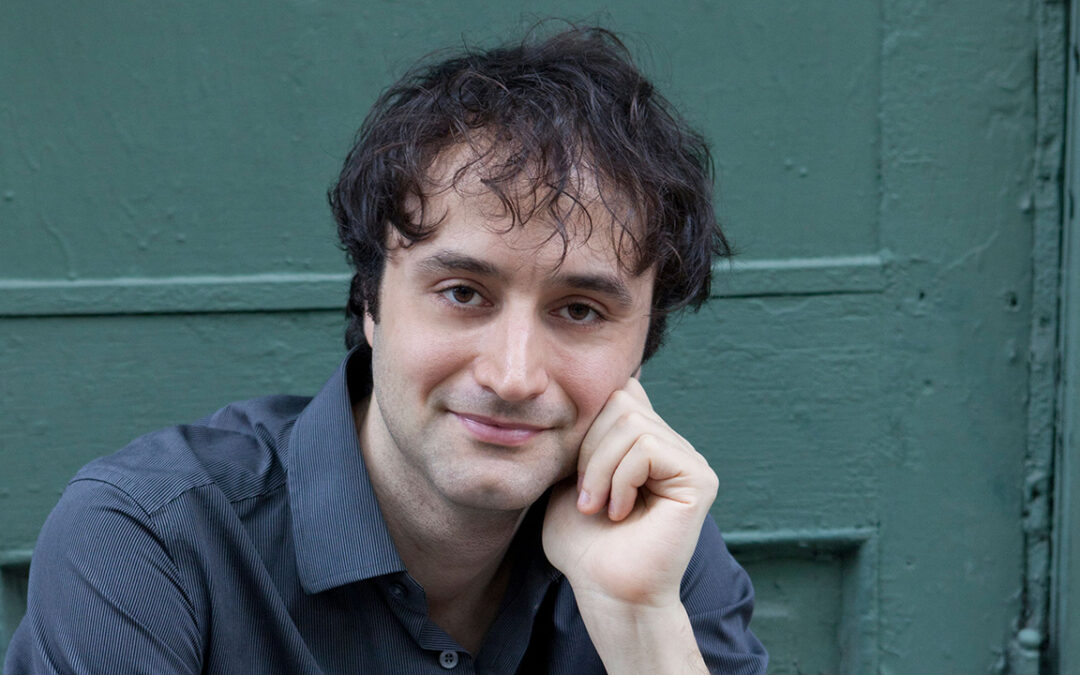
Pianist Ran Dank made his Festival debut in 2014, the same year he earned his doctorate in music from the CUNY Graduate Center, where he studied with such esteemed instructors as Ursula Oppens and Richard Goode. Prior to that, he’d honed his skills at The Juilliard School, where he received both a master’s degree and an artist diploma and was mentored by the likes of Emanuel Ax, Joseph Kalichstein, and Robert McDonald.
Having begun his piano studies at the age of seven in his native Israel, Dank earned his bachelor’s degree from the Rubin Academy of Music before moving to the United States in his early 20s. Over the past two decades, he’s built an international career that’s seen him win numerous honors and awards (he’s a laureate of the Cleveland, Hilton Head, Naumburg, and Sydney international piano competitions); perform with a wide range of ensembles, including the Cleveland Orchestra, Sydney Symphony Orchestra, and Orchestra of St. Luke’s; and appear in recital at such venues as New York’s Carnegie Hall and Washington, DC’s Kennedy Center.
Known for his devotion to contemporary music, Dank is acclaimed for his performances of Frederic Rzewski’s The People United Will Never Be Defeated! as well as his premieres—alongside his wife, the renowned pianist Soyeon Kate Lee (who’s another Festival-audience favorite)—of works for piano four-hands by Rzewski, Alexander Goehr, and Marc-André Hamelin. The Washington Post has praised Dank for his “impeccable technique,” while the Chicago Classical Review has called his playing “remarkable and complete in every way.”
Among Dank’s remarkable offerings at the Festival this season is a solo recital—held at noon on Thursday, July 23—that features works from the 18th, 19th, and 20th centuries, beginning with Bach’s wonderfully moody organ piece Ich ruf’ zu dir, Herr Jesu Christ (heard here in a gorgeous piano arrangement by Busoni) and continuing on to Gubaidulina’s Sonata, an early composition that reveals the composer’s modern mysticism. The recital also features virtuosic, one-of-a-kind works by Haydn, Liszt, and Ravel.
The day before his recital, at 6 p.m. on Wednesday, July 22, Dank plays Dvořák’s powerful Piano Trio in F Minor, and the following week, at 6 p.m. on Sunday, July 26, and Monday, July 27, you can catch him in a beloved early work by Beethoven—the Piano and Winds Quintet, whose instrumentation Beethoven took from Mozart’s 1784 quintet. Dank’s final performance of the season, at 6 p.m. on Wednesday, July 29, is Mozart’s highly demanding and highly virtuosic Piano Quartet in G Minor.